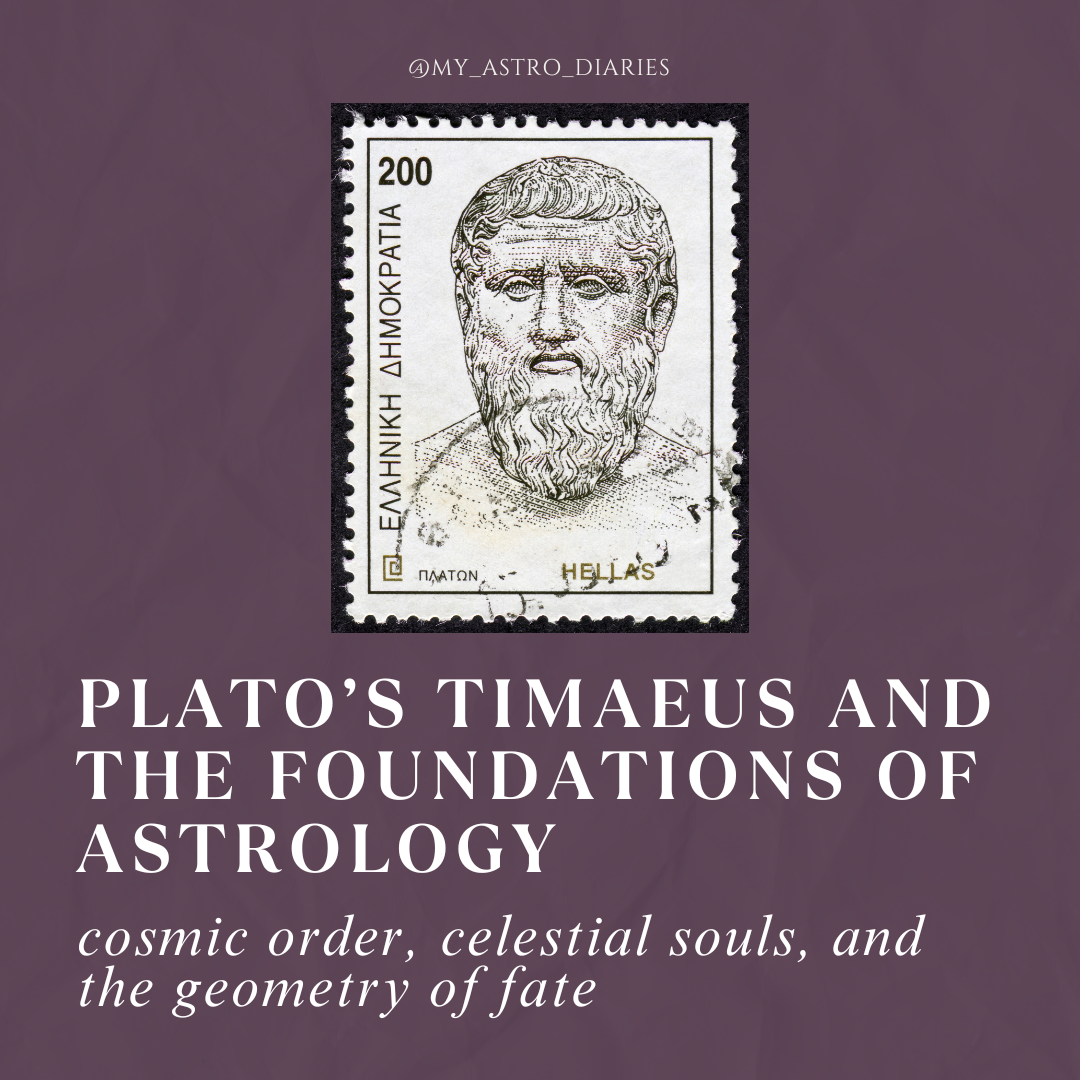
Plato’s Timaeus and the foundations of astrology
It all begins with an idea.
Plato’s Timaeus is one of the most influential attempts in Western thought to explain the origin, structure, and purpose of the universe. It’s part myth, part physics, part theology, and it stands at the crossroads of cosmology, metaphysics, and the early intellectual scaffolding of astrology.
However, Timaeus is not only a cornerstone of philosophy but also one of the most important texts in history, particularly for astrologers. The dialogue provides the metaphysical architecture that later astrologers, from the Hellenistic period to the Renaissance, used to justify the idea that celestial motions correspond to earthly events.
Far from being mere superstition, ancient astrology was and still is being approached on the Platonic conviction that the cosmos is an ordered, ensouled, harmonious living being whose rational structure is reflected everywhere within it, including the human soul.
In the following diary entry, let’s explore central ideas of the Timaeus, the Demiurge, the World Soul, celestial time, the geometry of matter, and the microcosm–macrocosm doctrine, which form the philosophical foundation of astrology.
Plato’s Timaeus and the cosmological roots of astrology
The dialogue opens (17a–27b) in the aftermath of the Republic, with Socrates asking to see his ideal city “set in motion,” embodied in a story that shows how such a city might perform in real historical circumstances. His three interlocutors, Timaeus the natural philosopher, Critias the statesman and storyteller, and Hermocrates the general, agree to supply such accounts.
Plato hints at a planned trilogy: the ethical order of the city (Republic), the cosmic order that grounds true morality (Timaeus), and a historical-mythical enactment of this order (Critias). The entire project suggests that morality is not a human convention but an expression of the deeper harmony of the macrocosm, a harmony the soul once perceived before its bodily birth.
This theme is precisely what later astrologers seized upon: the idea that the cosmos possesses a meaningful structure, and that human life unfolds within the same mathematical and moral order.
Mapping the scope of physics
Timaeus begins with a methodological prelude that sharply distinguishes being from becoming, the eternal Forms from the changing physical world. Because cosmology deals with becoming, not with eternal being, it can never attain the precision of dialectic. What we are about to hear is a likely story (eikos muthos), not a demonstrative science.
Yet, even a likely story can reveal the rational structure of the cosmos if guided by the proper causes. Here, Plato introduces two types of cause: the intelligent, which aims at the good, and the necessary, the blind and resistant substrate of matter.
Astrology, like Timaeus’ physics, interprets the realm of becoming through the lens of intelligible order.
Why does the universe exist? The Demiurge and cosmic purpose
Timaeus opens with a fundamental question: did the universe always exist, or was it formed? The claim is that the universe is organized out of chaos by a benevolent craftsman called the Demiurge.
The Demiurge is not a creator ex nihilo; he is a designer who imposes order on pre-existing disorder. And because he is good, he wills the world to be good.
Astrology inherits this assumption:
If the cosmos was built on goodness and reason, then the patterns we see in the sky aren’t just random, as they’re meant to mean something. The movements of the planets start to look less like accidents and more like the universe expressing its own underlying logic.
The forms and the ideal living creature
To craft the world, the Demiurge looks to the eternal forms. The most important is the form of the living creature, a perfect, single organism containing all forms of life.
The Demiurge models the universe upon this Form, making the world itself a living being.
This idea is quite crucial for astrology:
If the cosmos is an organism, then celestial bodies are its organs, and their movements express the life and mind of the whole.
The planets are not inert rocks as they are symbols of the cosmic body’s internal dynamics.
The body of the world (31b-34b), the four primary bodies, and the four elements in astrology
The Demiurge next shapes the body of the universe. He constructs the four primary bodies, fire, air, water, and earth, through geometry, assigning each a distinctive polyhedral form.
He fashions the cosmos as a complete whole containing all possible living types, then perfects it by giving it the form of a sphere, the shape that needs no appendages, evenly balanced and harmonious. At the center, he installs the World-Soul, anchoring the cosmos in rational order.
Here lie several roots of astrological thought: the spherical cosmos, the geometric basis of its elements, and the belief that the rational soul permeates the physical world. The sphere, smooth, unified, and mathematically optimal, becomes the model for the nested celestial spheres guiding astrological motion.
Fire - tetrahedron
Shape: a three-dimensional polyhedron with four triangular faces, six edges, and four vertices
Qualities: sharp, penetrating, mobile
Why: the tetrahedron has the fewest faces and the sharpest angles; it cuts, burns, and moves quickly (Martian/Solar energy). Plato uses this to explain the sensory qualities of heat and light: fire is made of the smallest and most active particles.
The tetrahedron’s activity makes fire the first and most transformative of the elements, initiating change, igniting motion, and activating potential in all other bodies. Fire is the elemental source of energy and creation, the spark of life and movement within the cosmos.
Astrology inherits Plato’s geometric logic when characterizing the fire signs, Aries, Leo, and Sagittarius. The tetrahedron’s sharpness, energy, and mobility provide the conceptual foundation for its symbolic traits.
Air - octahedron
Shape: eight triangular faces
Qualities: light, subtle, mobile
Why: its particles are larger and gentler than fire but still mobile and easily displaced. This shape is crucial for understanding why air behaves the way it does and why it sits between fire and water in the hierarchy of elements.
The many faces allow air particles to slip between other particles without breaking them apart. Air fills empty spaces, surrounds bodies, and moves effortlessly. The symmetry of the octahedron allows it to roll, rotate, and slide, and it maintains coherence without being rigid (Mercurial, airy Gemini nature). Plato’s physics suggests that air is the most adaptable of the three triangle-based elements.
Sign of Gemini inherits the pure motion of the octahedron: quickness, agility, and the ability to divide, combine, and rearrange ideas as readily as air particles shift in space. Gemini’s curiosity and adaptability mirror the octahedron’s capacity to link movements together and mediate changes between fire and water.
Libra reflects the octahedron’s equilibrium. The symmetry of its eight faces becomes the symbolic foundation of Libra’s sense of fairness, proportion, and aesthetic harmony. Just as air moves smoothly around obstacles, Libra manages social and moral fields with grace and moderation.
Aquarius embodies air at its most abstract and systemic, the octahedron viewed not only as a physical shape but as an organizing principle. Its geometric clarity becomes a metaphor for Aquarius’s ability to understand patterns, systems, and large-scale social or intellectual structures.
Water - the icosahedron
Shape: Twenty triangular faces
Water is assigned the icosahedron, the most complex of the Platonic solids, composed of twenty small, equilateral triangular faces. Among the elemental bodies constructed from the same primitive triangles, the icosahedron has both the greatest number of faces and the greatest curvature, producing a particle that is smooth, rounded, and easily set in motion.
Qualities: fluidity, adaptability
Why: its many faces create a smooth, flowing structure.
The icosahedron’s abundance of small faces produces a body that is inherently unstable in fixed arrangement: the more faces a solid has, the less each face contributes to structural rigidity.
This geometric construction gives water its dual character of gentleness and power. Gentle because it gives way to almost any force, powerful because its yielding allows it to wear down even the hardest earth over time.
The water signs in astrology, Cancer, Scorpio, and Pisces, are built directly upon the Platonic understanding of water as the most adaptive, receptive, and impressionable of the elements.
Thus, through the icosahedron, Plato not only defines the physics of water but inadvertently gives Western astrology the philosophical and symbolic foundation for understanding the emotional, perceptive, and imaginative nature of the water signs.
Earth - the cube
Shape: Six square faces
Plato assigns Earth the form of the cube, the only Platonic solid whose faces are perfect squares. Compared to the other elemental solids (each composed of equilateral triangles), the cube is uniquely stable, even, and grounded. Its six large faces and right-angled structure create a particle that resists rotation and displacement. In the geometric hierarchy of the cosmos, the cube represents solidity, permanence, and structural reliability.
Qualities: Stability, heaviness, resistance
Why: the cube is the most stable and immobile of the shapes
For Plato, the cube’s geometry itself accounts for Earth’s behavior. Square faces meet at right angles, enabling Earth’s particles to fit together symmetrically and without gaps. This reduces mobility and increases density. A body composed of such particles is naturally less affected by outside forces: it sinks rather than rises, holds its form rather than dissolving, and resists alteration rather than submitting to it.
The earth signs, Taurus, Virgo, and Capricorn, inherit this Platonic meaning: they are durable, grounded, and oriented toward what can be built, maintained, and sustained.
The world-soul is the brain of the universe
The universe must be a single, unified organism, Plato states. It is not a collection of separate worlds, but one coherent body, complete in itself…
Wholeness is central as every part of the cosmos is interconnected, and nothing is superfluous. This holistic structure reflects the Demiurge’s rational design: order, balance, and harmony are intrinsic to the universe.
Each element contributes to the stability and functionality of the whole, much like organs in a living body. Fire provides energy, air circulates motion, water lubricates and sustains, and earth anchors the structure. The cosmos is thus a macrocosmic living entity, embodying actual purpose in every part.
The central soul animates the universe, giving it life, intelligence, and rationality.
The sphere is the perfect form
Plato next declares that the sphere is the natural shape of the universe. Its perfection lies in:
Uniformity in all directions, with no weak points or corners
Self-containment, symbolizing completeness and unity
Balance, allowing equal distribution of motion and force
The spherical universe is therefore the most harmonious body possible, reflecting the eternal and immutable Forms that the Demiurge used as a model. Motion, light, and life emanate evenly from this form, ensuring that the cosmos functions as an integrated, rational whole.
The world-soul and the music of time = harmonies of the cosmos
In Timaeus 35a–39e, Plato elaborates on the composition and functioning of the World-Soul, the intelligent principle that animates the universe. This section reveals how the Demiurge structures not only matter but motion, time, and cosmic order according to rational and mathematical principles, which leads us to transits and progressions in astrology.
Composition: being, becoming, sameness, difference
Plato explains that the World-Soul is constructed from four fundamental components:
Being – the eternal, unchanging aspect of existence, reflecting the Forms
Becoming – the world of change, where matter is in flux
Sameness – unity, continuity, and the principle of identity
Difference – diversity, variation, and distinction between entities
These ingredients are combined according to precise mathematical ratios, producing a soul capable of both stability and adaptability. By blending permanence (being, sameness) with change (becoming, difference), the Demiurge ensures that the universe is both ordered and dynamic, capable of growth, motion, and variation while maintaining coherence.
The division into harmonic intervals
Plato next introduces the concept of harmony and musical proportion. The World-Soul is divided into harmonic intervals, forming a rational structure that governs cosmic motion.
Ratios of length, number, and time are applied to create proportional relationships, ensuring that the motions of the universe are balanced.
This is the origin of the famous “music of the spheres” (musica universalis), the idea that the heavens move according to mathematical harmony, producing a cosmic rhythm that reflects the rational order of the Demiurge.
Harmony actually ensures that the world operates consistently, with predictable cycles and stable relationships among elements, planets, and celestial spheres.
Time as the moving image of eternity
Time itself, Plato argues, is a product of motion. While the Forms are eternal and unchanging, the physical world requires a mechanism to measure change.
Time is defined as the moving image of eternity.
It arises from the rotation of the heavens, with the Sun, Moon, and planets marking intervals of days, months, and years.
By linking motion to measurement, Plato unites physical change with rational order, enabling humans to perceive and participate in the cosmos’s harmony.
Planets as instruments of time
The planets, embedded within the circles of the Same and the Different, function as living instruments that regulate the flow of time:
Their movements mark the passage of hours, days, seasons, and years.
They embody the rationality of the Demiurge, translating cosmic intelligence into observable phenomena.
In later astrological thought, these motions were interpreted as influences on human fate and fortune, because the planetary patterns mirror the harmonies of the World-Soul.
Plato’s vision positions the planets not as mere inert matter but as active participants in a living, rational, morally structured cosmos. Their motions are a manifestation of harmony embedded in the universe by the Demiurge.
The living harmony of the whole
The cosmos, for Plato, is not a lifeless mechanism turning by chance, but a living harmony, a being whose intelligence permeates every level of existence. To study the heavens, then, is not to gaze into cold emptiness, but to engage with the visible expression of divine reason.
Mathematics, geometry, and astronomy were not abstract disciplines but spiritual exercises, leading the soul upward from confusion toward clarity, from multiplicity toward unity. The heavens, governed by reason, invite the human soul to remember its kinship with that same order and to see a model of its own potential for timed unfolding with the planetary movements.
The Timaeus leaves us with a profound conviction: that the universe itself is a moral and intelligent organism, and that to understand it is to understand ourselves. The World-Soul binds all beings in one vast, harmonious life, a cosmos that thinks, breathes, and sings through time…
Until the next diary entry,